
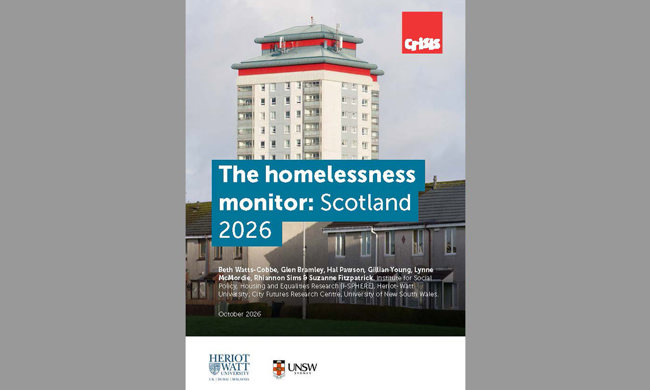
The Homelessness Monitor: Scotland 2026
08.10.2026
The Homelessness Monitor Scotland: 2026 was commissioned by Crisis and led by Heriot-Watt. This is part of the Homelessness Monitor series, which provides an independent analysis of the homelessness impacts of recent economic and policy developments across Great Britain.
This sixth Scotland-focused Monitor presents the number of households experiencing the worst forms of homelessness in Scotland, with analyses of recent trends in homelessness, local authority and other key informant insights, and the projected impact of policy interventions. These findings are especially pertinent now, as Scottish Government embarks on landmark reforms to the Scottish homelessness system.
Key findings
The findings of the Homelessness Monitor Scotland draw on a statistical modelling exercise that estimates levels of the worst forms of homelessness ('core' homelessness), and projects future trends. This is accompanied by a survey of local authorities and interviews with key informants in the public, academic and voluntary sectors, to contextualise these statistics.
The number of households experiencing the worst forms of homelessness in Scotland stands at 22,800, up 54% since 2020, and the number of people sleeping rough on an average night is estimated to be around 1,000 – double the low seen during the pandemic. Analysis of government data also shows that temporary accommodation placements stood reached a record high in 2025, and average lengths of stay have increased by 27% since 2019/20.
Local authorities surveyed for this research reported that they are currently limited by legal and funding arrangements in how far they can prioritise prevention work. Prevention was perceived to be especially difficult for people with complex needs, young people asked to leave the family home, those facing homelessness after the end of a relationship, and people with newly-granted refugee status leaving Home Office accommodation.
Without action, the rates of the worst forms of homelessness are projected to continue at a high level over the coming years. However, the analysis shows that a package of policy interventions could lead to a drop in core homelessness of 47% by 2028. Among the policy levers forecast to be most powerful is full implementation of the upcoming prevention duties.
Scottish Government is embarking on homelessness reforms with a focus on prevention - including a shared public responsibility for public services to ‘Ask and Act’ to prevent homelessness, and requiring local authorities to act earlier to support people six months before they could become homeless. Local authority and key informant insights highlight the importance of effectively resourcing and implementing these reforms, and the statistical modelling shows the potential fall in homelessness that can be achieved if this is done.
Looking at other individual policy interventions, increasing allocations of social housing to households experiencing homelessness has a strong project impact. The projections also show that higher social housing supply, increasing Housing First provision and uprating local housing allowance and other welfare benefits could also drive reductions in homelessness – underscoring the importance of the suitable housing, and support for people to maintain their homes, in ending homelessness.
Click on the PDFs below to read the executive summary or the full report.
Reference:
Watts-Cobbe, B., Bramley, G., Pawson, H., Young, G., McMordie, L., Sims, R., Fitzpatrick, S. (2026) The Homelessness Monitor: Scotland 2026. London: Crisis.
Downloads
Related content
The Homelessness Monitor: Scotland 2024
This fifth Scotland-focused Monitor report provides a state-of-the-nation look at homelessness in Scotland, and focuses in particular on ongoing implementation of the Scottish Government’s Ending Homelessness Together Action Plan, as well as the homelessness impacts of the ongoing cost of living crisis.
View more
The Homelessness Monitor: Scotland 2021
The Homelessness Monitor: Scotland 2021 is the latest edition of a longitudinal study into the ho...
View more