The plan has set out a package of solutions that are designed to cover each of our five definitions of homelessness ended. To meet this goal we need investment in the right services. To end homelessness we need services that prevent it from happening in the first place, that allow a rapid housing-led response; and that give people with multiple and complex needs the support they need to keep their home. This chapter sets out the costs and benefits of supporting homeless people in our five definitions of ending homelessness.
Homelessness generates a financial, social and economic burden for society. As an indication of current spending, in 2015-2016, in England alone, local authorities spent more than £1.1 billion on homelessness. More than three quarters of this was spent on temporary accommodation. In 2014 it was estimated that Scottish local authorities spent £94 million on temporary accommodation for homeless households.
In February 2018, we commissioned PricewaterhouseCoopers LLP (“PwC”) to estimate the expected costs and benefits of achieving this plan, through the different combinations of interventions (i.e. solutions) that we have identified are necessary to address and prevent homelessness. The contents of this chapter are taken from a report published by PwC (2018), Assessing the costs and benefits of our plan to end homelessness.
As set out in Chapter 3 we have defined what ending homelessness would mean in terms of achieving five objectives; Objectives 1 to 3 refer to people defined as ‘core’ homeless whereas Objectives 4 and 5 refer to ‘wider’ homelessness (see Chapter 5, ‘Projecting homelessness’ for more information). Drawing on the Heriot-Watt homelessness projections study,4 PwC have estimated how many households would need to be supported if the definition of ending homelessness is achieved. In total, nearly 246,000 households will need support in 2018 and this will rise to nearly 436,000 by 2041 with unchanged policies (see Table 15.1).
Crisis definition of ending homelessness and number of households across that definition
1. No one sleeping rough
2. No one forced to live in transient or dangerous accommodation such as tents, squats and non-residential buildings
3. No one living in emergency accommodation
4. No one homeless as a result of leaving a state institution such as prison or the care system
5. Everyone at immediate risk of homelessness gets the help they need that prevents it from happening
Source : figures based on Bramley, G. (Forthcoming) Homelessness projections: core, wider homelessness across Great Britain - extent, trends and prospects.
For each definition, as set out in this report, a combination of interventions (i.e. solutions) have been recommended to meet the stated aim.
Housing First
Housing First prioritises rapid access to a stable home for a homeless person and enables her or him to begin to address other support needs through coordinated wraparound support and case management. Permanent housing is provided without a test of having to be ‘housing ready’, and there is no obligation to engage in support services to continue to maintain a tenancy. Housing First is built upon the principle of a human right to housing, and harm reduction is taken above any other goals such as sobriety or abstinence. It is a model specifically designed for homeless people with complex and multiple needs. It proves most successful when it forms part of a wider integrated strategy to end homelessness. If required, this is followed by additional support through Housing First or low to medium support
Long term supported accommodation
Long term supported accommodation is designed to provide on-site intensive support for people needing specialist care and assistance who have become homeless. It is likely to be most suited to people with long term health needs who are unable to live independently and/or where Housing First is not a suitable option. The recommended package is envisaged to have an initial duration of three years followed by additional support (if required) through long term supported accommodation. In addition, we recognise that some groups require supported accommodation for fixed periods of time until they move into permanent independent accommodation. These include young people and those experiencing domestic violence.
Low to medium support for housing access
Help to access social and private rented sector accommodation through a social lettings agency and National Private Rented Access Scheme with a Guaranteed Deposit Scheme. The initial duration of the recommended package is two years of housing access support in combination with floating support (see below). This is followed by additional support for two years for those who require it.
Floating support
Floating support is offered in isolation or combined with the other interventions (eg support to access housing). It takes the form of in-tenancy support that helps people to sustain their housing in the long term.
Unsuitable temporary accommodation (7 day restriction)
These are types of temporary accommodation, such as unsupported hostels or bed and breakfast accommodation, that is of low standard with poor basic facilities, including inadequate access to toilet, washing and cooking facilities. We recommend that all homeless households across Great Britain are placed in this type of accommodation for no more than seven days before they move to suitable forms of temporary accommodation or permanent accommodation.
Housing Options
Local authority housing options services offer people a range of services to prevent and address their homelessness. These include keeping people in their existing home by means of mediation with their landlord or helping people access housing quickly by providing a deposit or working with a housing association to access social housing. We recommend that all people identified as homeless in the categories addressed in Objectives 4 and 5 receive initial support through Housing Options.
Critical Time Interventions
A time-limited evidence-based solution, which supports people who are vulnerable to homelessness during periods of transition. It is a housing-led approach that combines rapid housing access with intensive case management. The Critical Time Interventions support package includes one-year support through Critical Time Interventions which is expected to be followed by additional support through a Housing First or low to medium support package.
Assertive outreach programme
Assertive outreach is a form of street outreach that works with rough sleepers or people who live in tents, cars and public transport with support needs and seeks to end their homelessness.
Emergency accommodation
This package is used to help homeless people on a short-term basis until permanent housing is found for them. We recommend there is a local authority duty to provide emergency accommodation for up to 56 days for homeless people who have no safe, suitable, alternative accommodation.
Supported accommodation for young people
We recommend an intervention for some young homeless people who need supported accommodation for up to two years before they move on to independent accommodation with access to medium to low support or Critical Time Intervention packages.
Supported accommodation or victims of domestic violence
We recommend a package for victims of domestic violence who are at risk of homelessness. This package includes support for one year through long term supported accommodation which is expected to be followed by additional support through low to medium support or Critical Time Interventions packages.
To determine the expected costs and benefits of these solutions, PwC estimated how many households (or individual people) need to be supported by each recommended solution each year in the period from 2018 to 2041. The average unit cost was then multiplied per household (or per person). A similar approach was used to estimate the expected benefits.
The Heriot-Watt homelessness projections study shows the expected stock of homeless households at the end of each year in each category of homelessness. We do not know how many households flow in and out of different categories of homelessness over the whole period being considered as part of the cost benefit modelling (2018-2041). Neither do we know the flows between categories. Nevertheless, the initial stock estimates for each category of homelessness and the year-on-year changes between them (the ‘net inflows’) can be used to estimate how many households within each definition will need to be supported in each period. For example, for a given category (eg rough sleepers), PwC’s analysis assumes that the recommended solutions will initially target the stock of households classed as rough sleepers in 2018.
In the following year (2019), the analysis assumes that (any) additional households that become rough sleepers will need to be supported as well as continuing to support those from previous years who still require support. This is estimated as the difference between the number of rough sleepers in 2019 and the number in 2018. The same approach is applied for all years through to 2041. PwC’s analysis has focused on the expected economic costs and benefits of our recommended solutions to move people out of homelessness as outlined above. In addition to these solutions, the plan also envisages a series of other policy changes. These will help achieve the overall ambition of ending homelessness indirectly through the wider reforms. Examples include:
The costs (and benefits) of these other policy changes are not included in PwC’s estimates. This is because some elements of these costs (and benefits) are already included in PwC’s estimates of the solutions that directly contribute to achieving our objectives (eg cost and benefit attributed to supporting migrants out of homelessness). In addition, these policy changes may also have potential consequences beyond those people defined in objectives 1 to 5 (eg changes to LHA are likely to have a wider impact for people who are not homeless). Further analysis is required to understand how these policies (including housing supply and welfare reforms) may indirectly contribute to achieving our objectives but also their potential consequences for others in society (besides homeless people).
PwC’s analysis focuses on estimating the total economic costs and benefits associated with our recommended solutions under each of the five objectives. PwC worked with us to define these solutions, assess the available evidence about their effectiveness and agree a set of assumptions. For each solution, we identified the volume of people that are expected to be supported, the duration of the support, the potential pathways through different solutions and the cost per person supported. For more information please see PwC’s full report.
The approach is consistent with the HM Treasury Green Book principles on economic appraisal and evaluation, specifically the treatment of the counterfactual, the approach to estimating economic costs and benefits of policy solutions and the use of discounting.
The analysis includes four key features:
The full report sets out the costs and benefits of the solutions to achieve each objective. This includes the key data sources used in the analysis, the assumptions used to fill data gaps and the detailed results by definition of homelessness ended
Overall, PwC have estimated that the total discounted costs of the solutions recommended to achieve our definition of ending homelessness between 2018 and 2041 is £19,289m, at 2017 prices.
The costs are distributed across the five objectives, and reflect the number of people projected to be in each of these categories, plus differences in the unit cost of the solutions recommended (see Table 15.3). The largest costs are to achieve Objective 2 (ie no one forced to live in transient or dangerous accommodation) and Objective 3 (ie no one forced to live in emergency accommodation without a plan for rapid rehousing). Together these make up 87% of the estimated total costs.
Greater London
Objective 1 = £602
Objective 2 = £3,651
Objective 3 = £5,285
Objective 4 = £28
Objective 5 = £547
Total =£10,113
North
Objective 1 = £115
Objective 2 = £1,457
Objective 3 = £936
Objective 4 = £23
Objective 5 = £225
Total =£2,756
Midlands
Objective 1 = £62
Objective 2 = £838
Objective 3 = £582
Objective 4 = £13
Objective 5 = £152
Total =£1,646
South
Objective 1 = £150
Objective 2 = £1,507
Objective 3 = £1,174
Objective 4 = £24
Objective 5 = £336
Total =£3,191
Wales
Objective 1 = £18
Objective 2 = £370
Objective 3 = £101
Objective 4 = £3
Objective 5 = £42
Total =£535
Scotland
Objective 1 = £46
Objective 2 = £496
Objective 3 = £423
Objective 4 = £7
Objective 5 = £76
Total =£1,048
Great Britain
Objective 1 = £992
Objective 2 = £8,320
Objective 3 = £8,501
Objective 4 = £98
Objective 5 = £1,378
Total =£19,289
Source: PwC 2018
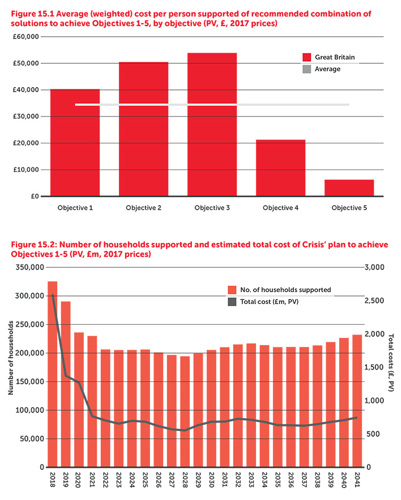
As described in Table 15.2 we are recommending combinations of interventions (solutions) to achieve our objectives; a different mix of these solutions will support people in each objective. The (weighted) average cost per person supported by the recommended mix of solutions across the five objectives between 2018 and 2041 is £34,460 but ranges from £53,900 – the (weighted) average cost per person of the mix of solutions recommended to achieve Objective 3 – to £6,282 – the average cost per person supported of the mix of solutions recommended to achieve Objective 5 (see Figure 15.1). On average, the cost per person supported of the mix of solutions to address ‘core’ homelessness (Objectives 1-3) is 3.5 times higher than the average cost of the mix of solutions to prevent homelessness for people at immediate risk of ‘core’ homelessness (Objectives 4-5).
Source: PwC 2018
Greater London
Objective 1 = £1,889
Objective 2 = £10,702
Objective 3 = £15,450
Objective 4 = £89
Objective 5 = £1,389
Total =£29,518
North
Objective 1 = £376
Objective 2 = £3,646
Objective 3 = £1,852
Objective 4 = £75
Objective 5 = £621
Total =£6,570
Midlands
Objective 1 = £215
Objective 2 = £2,451
Objective 3 = £1,426
Objective 4 = £42
Objective 5 = £423
Total =£4,557
South
Objective 1 = £513
Objective 2 = £4,398
Objective 3 = £2,900
Objective 4 = £77
Objective 5 = £924
Total = £8,811
Wales
Objective 1 = £60
Objective 2 = £1,043
Objective 3 = £240
Objective 4 = £11
Objective 5 = £118
Total = £1,472
Scotland
Objective 1 = £154
Objective 2 = £1,455
Objective 3 = £1,140
Objective 4 = £23
Objective 5 = £207
Total =£2,979
Great Britain
Objective 1 = £3,207
Objective 2 = £23,694
Objective 3 = £23,008
Objective 4 = £318
Objective 5 = £3,681
Total =£53,908
Source: PwC 2018
Source: PwC 2018
Figure 15.3 shows that nearly half of the estimated benefits accrue to local authorities over the period 2018 to 2041. They save £26,417m through reduced or avoided use of homeless services (eg reduced need for spending on temporary accommodation and other housing and support based services for homeless people funded by local authorities. Improved wellbeing as a result of people obtaining secure housing accounts for 27 per cent of the projected benefits (£14,646m), while increased economic output as a result of people entering employment (an estimate of their increased earnings) accounts for 12 per cent (£6,483m) of the total estimated benefits.
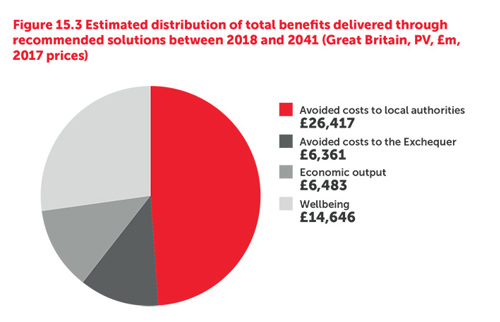
Outside of local authority budgets, the Exchequer is projected to save around £6,361m (12%) through reduced use of public services such as NHS and criminal justice system services as previously homeless people are moved out of homelessness and, on average, are expected to use these services with a lower frequency. Increased tax and other contributions from people who enter employment also contribute to the savings estimated for the Exchequer. PwC’s analysis also accounts for a potential increase in the number of Jobseekers Allowance claimants as people who previously were not claiming but were entitled to Job Seekers Allowance receive support and guidance in relation to the benefit system and begin claiming (a financial cost to the Exchequer).
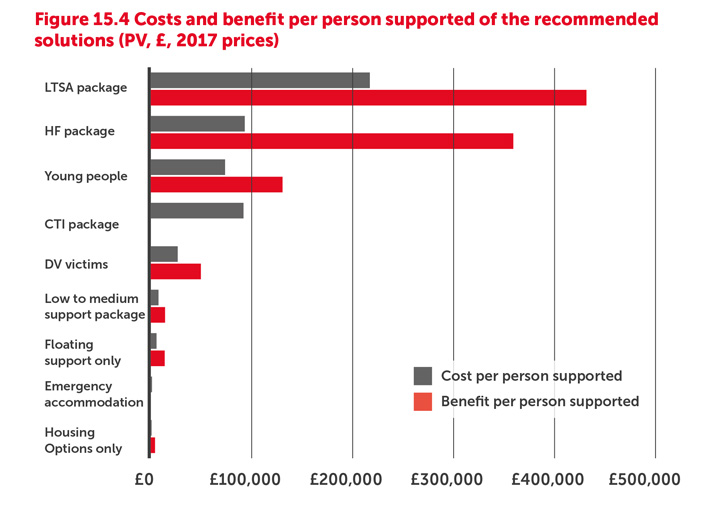
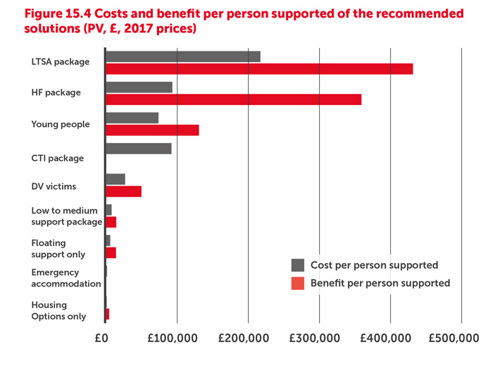
Figure 15.4 shows the costs and benefits per person of our recommended solutions to achieve our definition of ending homelessness. The long term supported accommodation solution which is expected to support people in Objectives 1 to 3, is estimated to have the highest costs (£6,338m or 33% of the total costs). It is closely followed by the Housing First package, which also contributes around 33% (£6,225m). The low to medium support package (housing access and floating support) and the Critical Time Intervention packages contribute a further 12 per cent and 10 per cent respectively to total costs. These results are driven by the numbers of people expected to need each package and the cost per person of different types of support. More intensive long term supported accommodation and Housing First packages have higher costs but also greater benefits.
In summary, in present value terms, for every £1 that will be invested in the solutions recommended to achieve Objectives 1 to 5, it is estimated that £2.8 will be generated in benefits – this includes cashable savings and wellbeing value. This is an overall benefit-cost ratio of 2.8. The benefit-cost ratio varies by objective from 3.2 for Objective 1 (people who are rough sleeping) to 2.7 for Objective 5 (people who are at immediate risk of core homelessness).
More than half (£9,938m, or 52%) of the total discounted costs are expected to occur between 2018 and 2027 alongside nearly half (£26,426m, or 49%) of the total discounted benefits.
In summary, in present value terms, for every £1 that will be invested in the solutions recommended to achieve Objectives 1 to 5, it is estimated that £2.8 will be generated in benefits – this includes cashable savings and wellbeing value. This is an overall benefit-cost ratio of 2.8. The benefit cost ratio varies by objective from 3.2 for Objective 1 (people who are rough sleeping) to 2.7 for Objective 5 (people who are at immediate risk of core homelessness). More than half (£9,938m, or 52%) of the total discounted costs are expected to occur between 2018 and 2027 alongside nearly half (£26,426m, or 49%) of the total discounted benefits.


